
“A Nation That Cannot Feed Itself Remains Vulnerable” — Agric Minister Opoku Links Food Sovereignty to National Security
Gladson Afriyie
Journalist · Ghana Ntentan
Advertisement
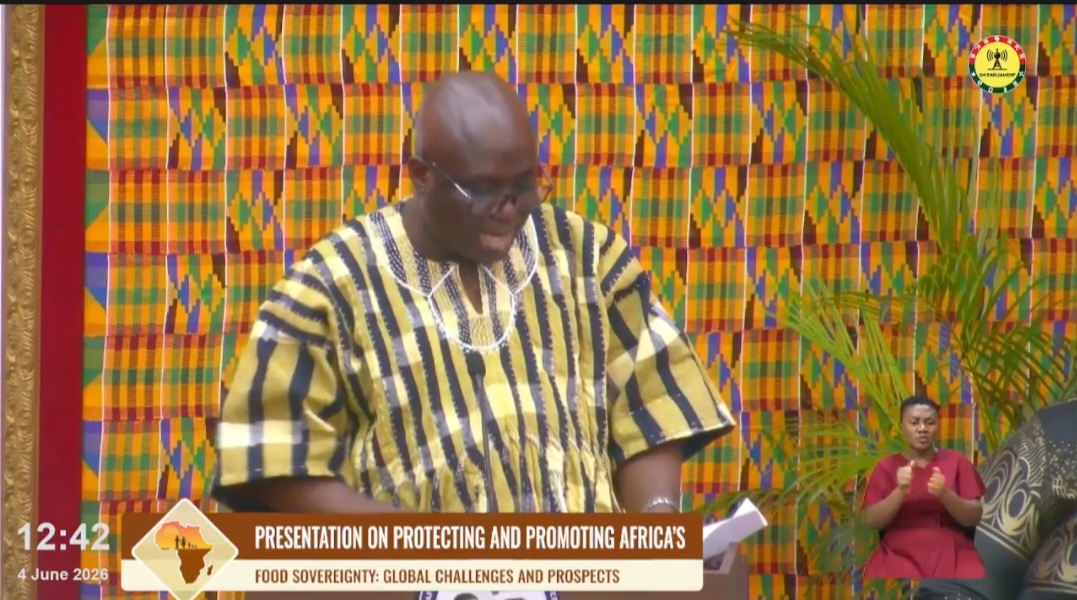
Minister of Food and Agriculture Hon. Eric Opoku has warned that recent global shocks have exposed the danger of relying on fragile international food supply chains, insisting that food sovereignty is now a “strategic national security issue” for Africa.
Addressing lawmakers at the 4th African Inter-Parliamentary Conference on Family Sovereignty and Values in Parliament, Hon. Opoku said the last three decades have made food sovereignty more relevant than ever.
“Recent global events have exposed the fragility of international food supply chains,” he said. “The COVID-19 pandemic disrupted transportation and logistic networks. The Russia-Ukraine conflict significantly affected global grain, fertilizer and energy markets. Climate-related disasters have reduced agricultural output in many regions.”
He added that rising geopolitical tensions have increased uncertainty over food availability and prices. “These developments have taught a critical lesson,” Hon. Opoku told the House. “A nation that cannot feed itself remains vulnerable.”
The Minister stressed that food security goes beyond agriculture. “It is a strategic national security issue,” he said.
He added that, Food sovereignty gives countries authority to define their own agricultural, fisheries, labour and land use policies.
Hon. Opoku said food sovereignty emphasizes locally produced food, culturally appropriate diets, environmental sustainability, equitable access to resources, and democratic control over food systems.
“Most importantly, it seems to place control of food production back into the hands of farmers and communities rather than leaving it exclusively in the hands of multinational corporations and global market forces,” he said.
The Minister traced the concept’s global roots to the historic Nyeleni Food Sovereignty Forum held in Mali in 2007. The forum brought together approximately 500 delegates from every continent to deepen understanding of food sovereignty and develop a shared agenda.
He stated that, Africa’s failure to feed itself is not due to lack of resources but policy and structural gaps.
“We turn our attention to Africa, we encounter a paradox that demands urgent action,” Hon. Opoku said in Parliament. “Africa is not poor in agricultural resources.”
He listed the continent’s advantages: roughly 60% of the world’s remaining uncultivated arable land, extensive freshwater resources, abundant sunshine, diverse agroecological zones, and a youthful population capable of driving agricultural transformation. Africa also holds “centuries of indigenous knowledge and agricultural traditions that have sustained communities for generations,” he added.
Advertisement
About the Author
Gladson Afriyie
Journalist at Ghana Ntentan
Gladson Afriyie covers the latest developments in Ghana and across Africa for Ghana Ntentan. With a focus on accurate reporting and in-depth analysis, they bring context and clarity to the stories that matter most to Ghanaians.