Minority Backs Presbyterian Church’s ‘Red Sunday’ Anti-Galamsey Push, Demands Legal Framework for NAIMOS
Gladson Afriyie
Journalist · Ghana Ntentan
Advertisement
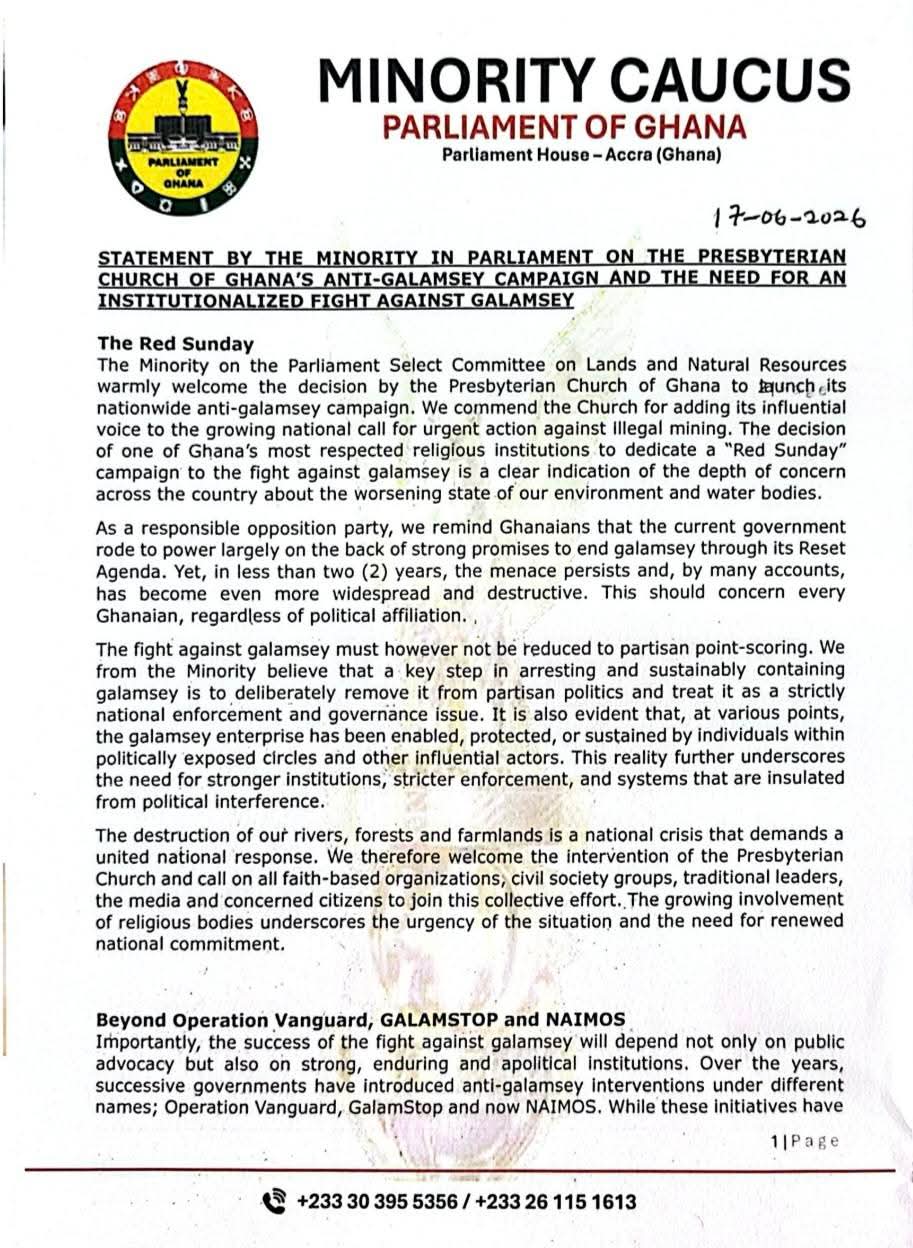
The Minority Caucus in Parliament has commended the Presbyterian Church of Ghana for launching its nationwide anti-galamsey campaign, describing the Church’s “Red Sunday” initiative as proof of deep national concern over illegal mining.
In a statement dated June 17, 2026, signed by Hon. Kwaku Ampratwum-Sarpong, MP for Mampong and Ranking Member on the Lands and Natural Resources Committee, the Minority welcomed the Church’s “influential voice” in the fight against galamsey.
*“Menace Has Become More Widespread” Under Current Gov’t – Minority*
The Minority reminded Ghanaians that the current government “rode to power largely on the back of strong promises to end galamsey through its Reset Agenda.” Yet, it said, “in less than two years, the menace persists and, by many accounts, has become even more widespread and destructive.”
“This should concern every Ghanaian, regardless of political affiliation,” the statement noted.
*Call to Depoliticize Galamsey Fight*
The Caucus stressed that the fight against illegal mining “must however not be reduced to partisan point-scoring.” It argued that a key step to “arresting and sustainably containing galamsey is to deliberately remove it from partisan politics and treat it as a strictly national enforcement and governance issue.”
It added that the galamsey enterprise “has been enabled, protected, or sustained by individuals within politically exposed circles and other influential actors,” underscoring the need for “stronger institutions, stricter enforcement, and systems that are insulated from political interference.”
*Beyond Operation Vanguard: Push for Permanent Solution*
Citing past interventions like Operation Vanguard, GalamStop, and now NAIMOS, the Minority said “the mere rebranding of enforcement structures is not enough to address a problem of this magnitude.”
“What Ghana needs is a sustainable institutional framework that transcends political administrations,” the statement said. It called for NAIMOS to be formalized through Legislative Instruments (L.I.) that define its mandate, powers, structure, accountability mechanisms, and operational independence.
“Such legal backing would help shield the fight against illegal mining from political interference, ensure continuity across governments and establish a more credible and permanent national response,” Hon. Ampratwum-Sarpong stated.
Advertisement
About the Author
Gladson Afriyie
Journalist at Ghana Ntentan
Gladson Afriyie covers the latest developments in Ghana and across Africa for Ghana Ntentan. With a focus on accurate reporting and in-depth analysis, they bring context and clarity to the stories that matter most to Ghanaians.