
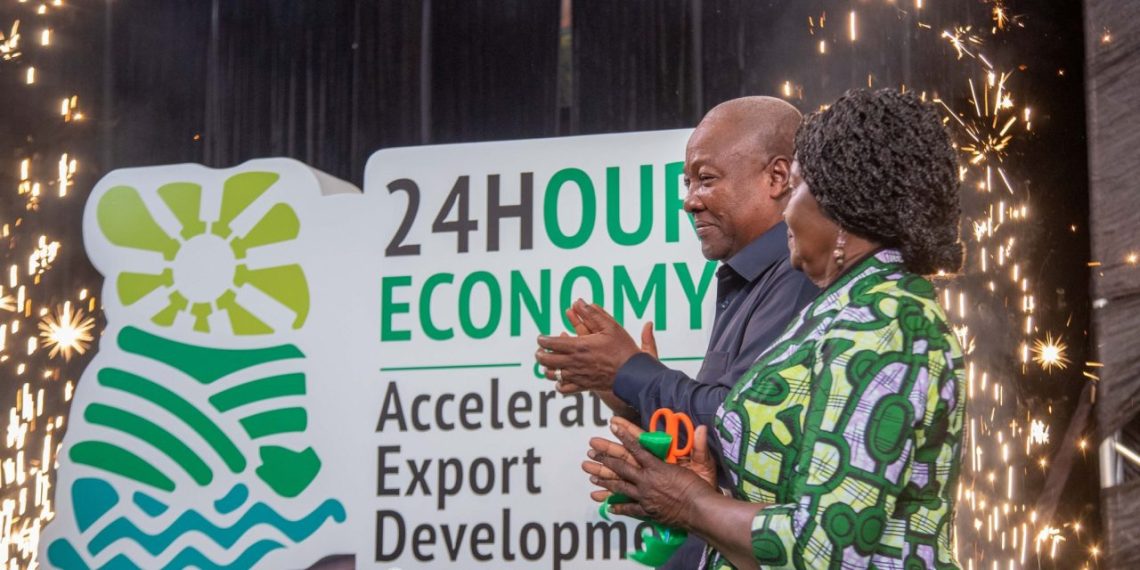
24-Hour Economy “Already Delivering” — Secretariat Cites $5.5bn Deals, 268 Filling Stations On Multi-Shift
Gladson Afriyie
Journalist · Ghana Ntentan
Advertisement
The Secretariat of the 24-Hour Economy programme says the policy is not just on paper, and is already attracting investments, expanding round-the-clock services and boosting industry.
In a statement responding to criticisms, the Secretariat said as of May 2026 the programme had secured $5.5 billion in Joint Development Agreements with co-development partners.
It also disclosed that 268 filling stations and 33 manufacturing companies have started operating under the initiative’s multi-shift model.
The response follows comments by Ranking Member of Parliament’s Economy and Development Committee, Kojo Oppong Nkrumah, who questioned what the programme had achieved since launch and suggested huge public funds had been committed with little to show.
The Secretariat said success should not be judged by direct government spending, but by “the investment the Programme mobilises and the production, exports and jobs it generates.”
It is targeting 1.7 million decent jobs by the end of 2028. According to the Secretariat, four agreements signed in the last 90 days alone are expected to create more than 160,000 direct jobs.
On claims that the programme had used part of the GH¢650 billion approved by Parliament in the last two years, the Secretariat disagreed.
“The GHS 650 billion cited by Hon. Oppong Nkrumah is the total that Parliament has appropriated for all government programmes over the past two years. It is by no means the expenditure made by or on the 24-Hour Economy,” it stated.
The Secretariat explained that the policy is driven mainly by private investment. Both Ghanaian and foreign companies are expected to fund most projects, with government’s role limited to project preparation, viability gap financing and coordination.
“Almost all of the projects are funded by private investors: Ghanaian and foreign companies and cooperatives,” it said.
Some of the flagship projects cited include the $1.45 billion Buipe solar and battery project, projected to produce 1,500 megawatts of power and create about 13,000 jobs, and the $250 million Kambonwule oil palm complex, expected to generate 120,000 jobs at full capacity.
The Secretariat also noted that several public institutions — including DVLA, Ghana Publishing Company and the Ghana Ports and Harbours Authority — have introduced 24-hour operations.
Advertisement
About the Author
Gladson Afriyie
Journalist at Ghana Ntentan
Gladson Afriyie covers the latest developments in Ghana and across Africa for Ghana Ntentan. With a focus on accurate reporting and in-depth analysis, they bring context and clarity to the stories that matter most to Ghanaians.