

Ghana Needs 24-Hour Production, Not 24-Hour Markets – KNUST Physicist Argues
Gladson Afriyie
Journalist · Ghana Ntentan
Advertisement
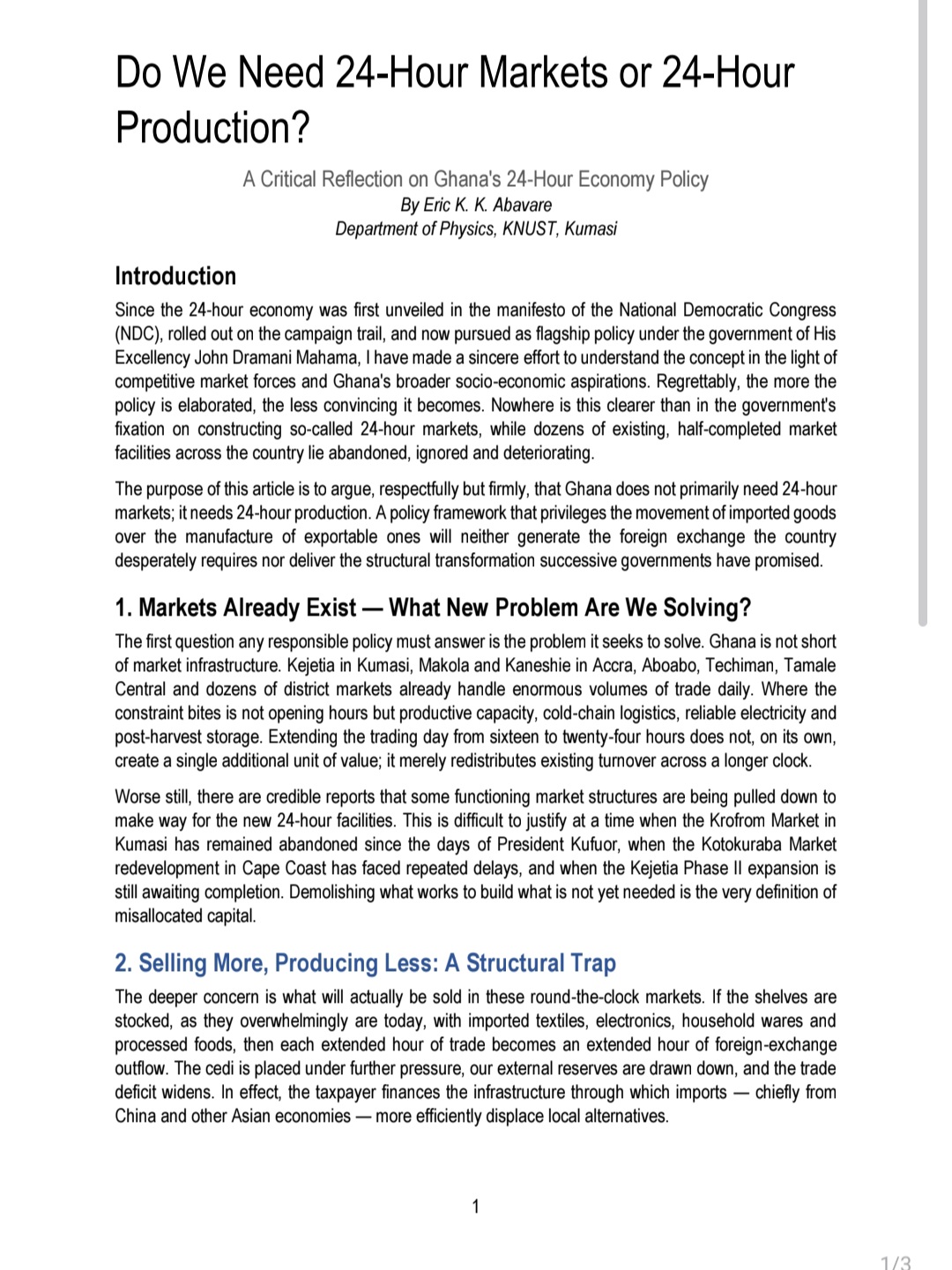
A Senior Lecturer at the Department of Physics, KNUST, Eric K. K. Abavare, has questioned government’s focus on building 24-hour markets, arguing that what Ghana needs is 24-hour production.
In a critical reflection titled _“Do We Need 24-Hour Markets or 24-Hour Production?”_, the academic said while the 24-hour economy policy was a flagship promise of the NDC and is now being pursued under President John Dramani Mahama, its current implementation raises concerns.
He argues that Ghana is not short of market infrastructure, citing Kejetia in Kumasi, Makola and Kaneshie in Accra, Aboabo, Techiman, Tamale Central and dozens of district markets that already handle huge volumes of trade daily.
According to him, the real constraints are productive capacity, cold-chain logistics, reliable electricity and post-harvest storage. Extending trading hours from 16 to 24 hours, he says, does not create additional value but merely redistributes existing turnover.
He also raised concern about reports that some functioning market structures are being pulled down to make way for new 24-hour facilities, at a time when the Krofrom Market in Kumasi has been abandoned since the Kufuor era, Kotokuraba Market redevelopment in Cape Coast has suffered delays, and Kejetia Phase II is still incomplete.
*On Selling More, Producing Less*
Dr. Abavare warns that the deeper problem is what will be sold in the round-the-clock markets. He notes that most shelves today are stocked with imported textiles, electronics, household wares and processed foods. Extending trading hours for such goods, he argues, extends foreign-exchange outflow, puts pressure on the cedi and widens the trade deficit.
He contrasts Ghana’s approach with models like Shenzhen in China, where factories, ports and logistics operate 24 hours to produce for the world, and Ho Chi Minh City, where night shifts serve export-oriented factories. In those cases, he says, the 24-hour rhythm is a symptom of a productive economy, not a policy imposed on a consumptive one.
He argues that an intellectually honest 24-hour economy should prioritize factories, agro-processing plants, pharmaceutical facilities and assembly lines running three shifts and exporting surplus for foreign exchange – such as a cocoa-processing plant in Suhum, shea-butter refinery in Tamale, garment factory in Tema Export Processing Zone or cashew-processing unit in Wenchi.
*MBA Syndrome and Abandoned Priorities*
Advertisement
About the Author
Gladson Afriyie
Journalist at Ghana Ntentan
Gladson Afriyie covers the latest developments in Ghana and across Africa for Ghana Ntentan. With a focus on accurate reporting and in-depth analysis, they bring context and clarity to the stories that matter most to Ghanaians.