Mahama Directs GJA and MFWA To Lead National Dialogue On Hate Speech
Gladson Afriyie
Journalist · Ghana Ntentan
Advertisement
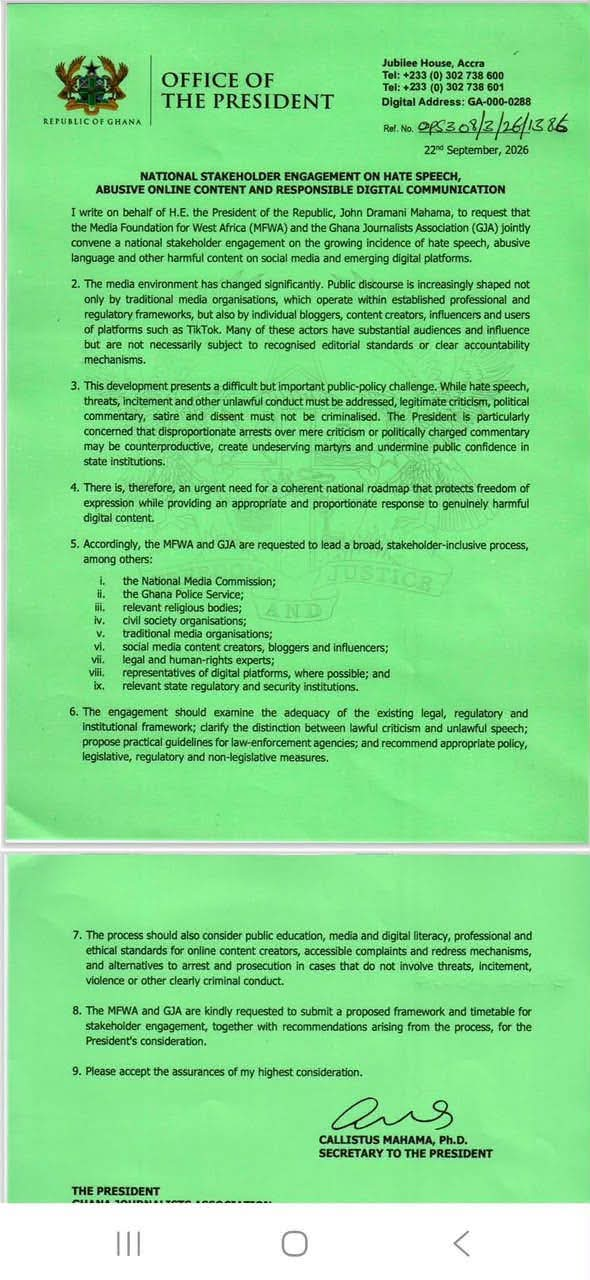
President John Dramani Mahama has directed the Ghana Journalists Association and the Media Foundation for West Africa to jointly convene a national stakeholder engagement on hate speech, abusive language and responsible digital communication.
The directive is contained in a letter from the Jubilee House dated 22nd September, 2026.
According to the letter, the President is concerned about the growing incidence of hate speech, threats, incitement and other harmful content on social media and emerging digital platforms like TikTok.
The letter notes that public discourse is now heavily shaped not only by traditional media, which operate under established professional and regulatory frameworks, but also by individual bloggers, content creators and influencers who command large audiences but are not subject to editorial standards or accountability mechanisms.
The President described it as a difficult but important public policy challenge, stressing that while hate speech and unlawful conduct must be addressed, legitimate criticism, political commentary, satire and dissent must not be criminalised.
He further cautioned against disproportionate arrests over mere criticism or politically charged commentary, saying such actions are counterproductive, create undeserving martyrs and undermine public confidence in state institutions.
He said there is therefore an urgent need for a coherent national roadmap that protects freedom of expression while providing an appropriate and proportionate response to genuinely harmful content.
The GJA and MFWA are expected to lead a broad consultative process involving the National Media Commission, Ghana Police Service, religious bodies, civil society, traditional media, social media content creators, bloggers, influencers, legal and human rights experts, representatives of digital platforms and relevant regulatory and security institutions.
The engagement is to examine the adequacy of existing laws, clarify the distinction between lawful criticism and unlawful speech, propose guidelines for law enforcement, and recommend policy, legislative and non-legislative measures.
It is also to consider public education, digital literacy, ethical standards for online creators, complaints and redress mechanisms, and alternatives to arrest and prosecution where there are no threats, incitement or violence.
The two bodies have been asked to submit a proposed framework and timetable for the engagement, together with recommendations, for the President's consideration.
Advertisement
About the Author
Gladson Afriyie
Journalist at Ghana Ntentan
Gladson Afriyie covers the latest developments in Ghana and across Africa for Ghana Ntentan. With a focus on accurate reporting and in-depth analysis, they bring context and clarity to the stories that matter most to Ghanaians.